On the outskirts of Riyadh, a 400-year-old building tradition is shaping a new city where historic methods meet contemporary planning
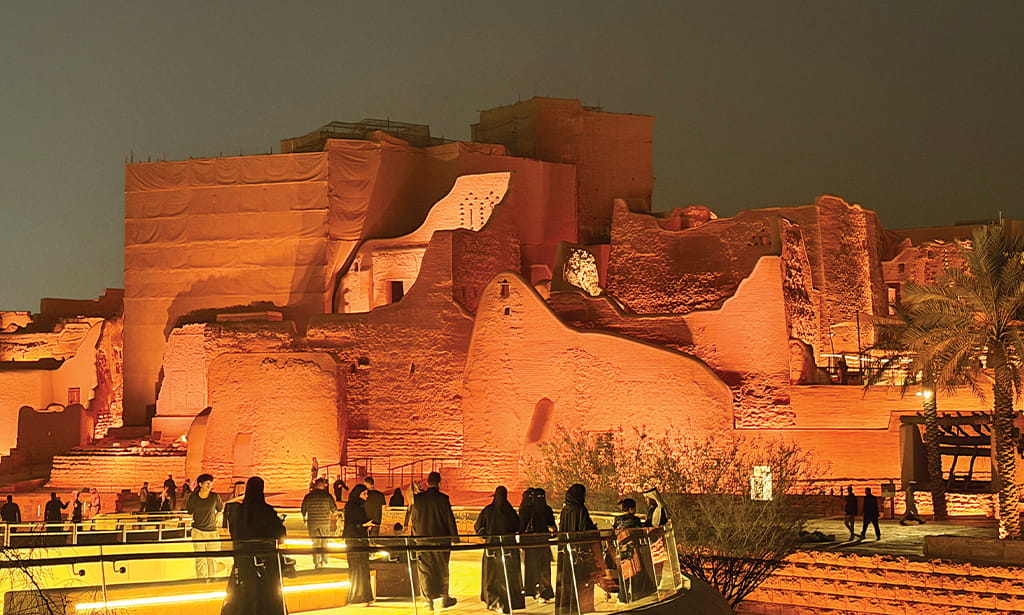
Imagine being asked to design a city of the future in Saudi Arabia – and confidently choosing mud over glass, steel, and concrete. At first, the idea seems improbable. Yet on the outskirts of Riyadh stands proof that this material choice is not experimental but time-tested. More than 400 years ago, a settlement rose beside Wadi Hanifah using sun-dried mud bricks, and much of it still stands today. Thick earthen walls, unlike glass and steel, do not store and radiate heat back into the streets after sunset. Instead, they regulate temperature naturally – a passive cooling system centuries ahead of its time.
The materials are drawn directly from the landscape: clay, sand, silt from the riverbed and straw, compacted into blocks and cured under the desert sun. This vernacular architecture forms the foundation of Diriyah, now being reimagined as one of the most ambitious heritage-led urban developments in the world.
The transformation of Diriyah was initiated under the vision of Crown Prince Mohammed bin Salman, with the establishment of the Diriyah Gate Development Authority in 2017, backed by the Public Investment Fund. The objective is not simply expansion, but the creation of a global cultural capital rooted in Najid architectural identity.
Urban planning here deliberately rejects the rigid grid. Homes, workplaces, schools, retail, wellness and cultural spaces sit within walkable proximity, creating an organic, human-scaled environment. Low-rise structures blend with the landscape, positioned beside At-Turaif, the UNESCO World Heritage Site that served as the ancestral home of the House of Al Saud and the birthplace of the first Saudi state in 1727.

The scale is formidable. Diriyah spans approximately 196 square kilometres, with over 14 square kilometres of built development carefully planned. The project will deliver schools, healthcare facilities, a university, museums, cultural institutions, 37 hotels, a 27 hole golf course designed by Greg Norman, a golf academy, and housing for around 100,000 residents.
Yet the most remarkable engineering lies underground. To preserve a serene, pedestrian-friendly surface environment free from traffic noise, more than 12 million cubic metres of rock have been excavated to create a three-tier subterranean infrastructure network reaching impressive depths of 46 metres. This concealed layer efficiently accommodates transport links, utilities, metro connections, and parking – keeping vehicles largely out of sight while maintaining full accessibility.
Landscaping plays an equally strategic role. Over six million trees and plants are being introduced, linked by parks, trails, and equestrian paths extending more than 20 kilometres. The result is not simply urban expansion, but the construction of a living, resilient ecosystem. For international observers, Diriyah signals a broader shift in Middle Eastern development – from iconic vertical skylines towards culturally anchored, climate-responsive urbanism. It positions Saudi Arabia not only as a builder of scale, but also as a thoughtful curator of heritage and sustainable design.
In an era when cities compete for global capital, tourism, and talent, Diriyah represents a fundamentally different proposition: a future city thoughtfully built from the materials of its past.