Entrepreneur Chris Ingram began collecting art in 2002. Drawn to modern British painters, he was once told at a Sotheby’s auction he could build a great collection for as little as £1 million. “Right, I’m in,” he thought, before quickly spending far more in pursuit of his passion.
Jo Baring, director of what became the Ingram Collection, recounts the story as she guides visitors through People Watching at the Dorset Museum & Art Gallery. Sharing art is central to the charity’s mission, she says. “What upsets Chris most are the beautiful works sitting unseen in storage.”
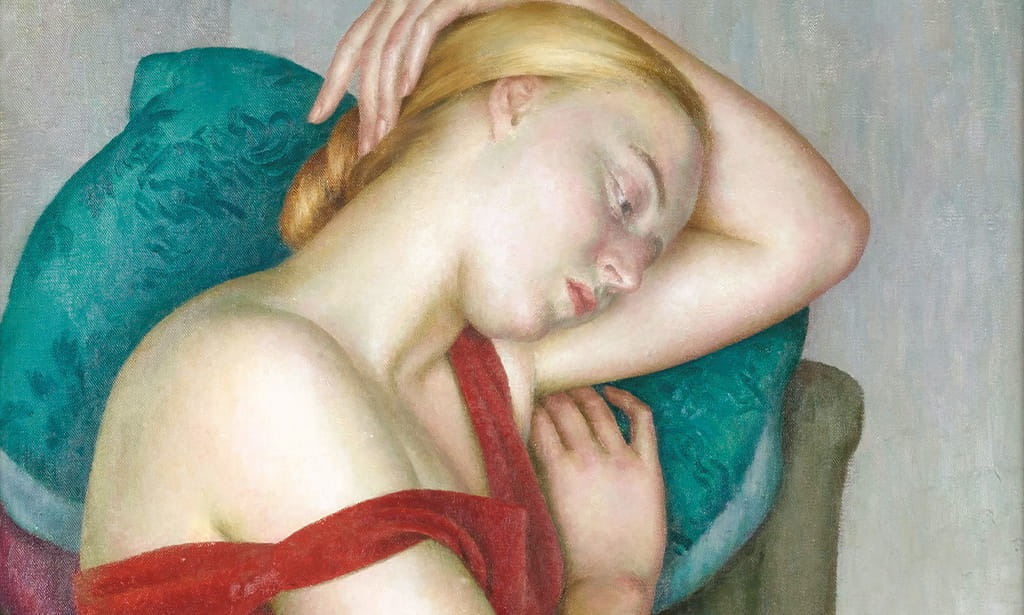
While names such as Elizabeth Frink, Henry Moore, Barbara Hepworth and Bridget Riley draw crowds, it is the lesser-known artists that give the collection its distinctive richness and unexpected depth. Arranged thematically into five sections, the exhibition opens with Dod Proctor’s Golden Girl, acquired before the artist’s market surge.
Until 10th May at the Dorset Museum & Gallery, Dorchester, UK www.dorsetmuseum.org

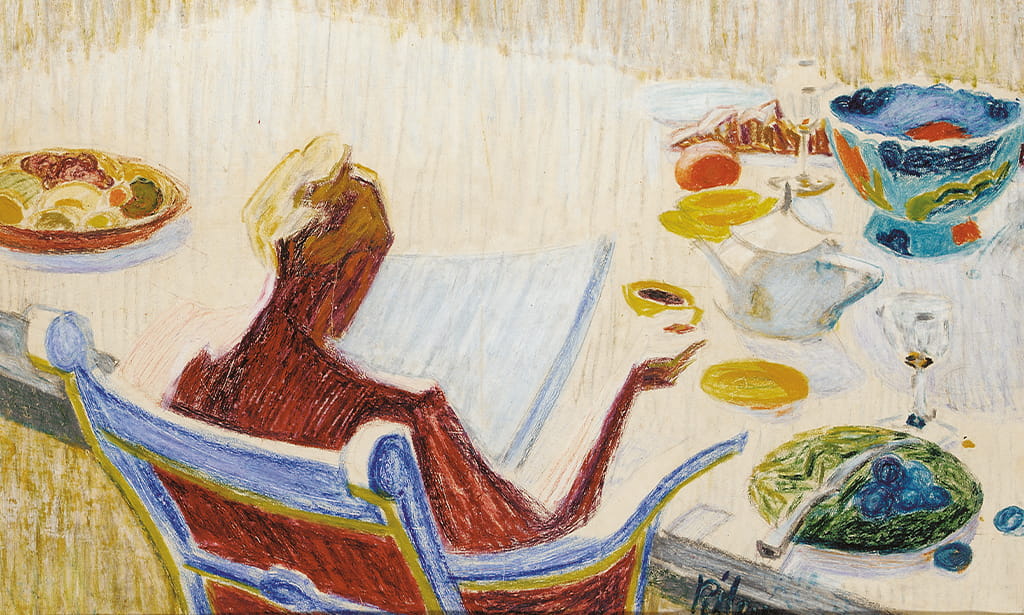
Highlights include Bridget Riley’s early Woman at Tea Table, shown publicly for the first time, hinting at the abstraction to come. Elsewhere, works explore people at leisure and at work, from Edward Burra’s seamen to Hughie Beattie’s football scene Rooney Intercepts,
reflecting Ingram’s belief in accessibility without hierarchy. The show also features contemporary voices, including Amy Beager’s Bobbidi, a winner of the Ingram Collection’s annual art prize, celebrating emerging British talent today.
While names such as Elizabeth Frink, Henry Moore, Barbara Hepworth and Bridget Riley draw crowds, it is the lesser-known artists that give the collection its distinctive richness and unexpected depth. Arranged thematically into five sections, the exhibition opens with Dod Proctor’s Golden Girl, acquired before the artist’s market surge.
Winston Churchill: The Painter

The first major retrospective of Sir Winston Churchill’s paintings opens this spring at London’s Wallace Collection. Churchill took up painting at 40, encouraged by his sister, a watercolourist, and by friends such as Sir John Lavery and Walter Sickert, following the disastrous Gallipoli campaign of 1915. Painting became a refuge from political stress and depression, with Churchill later writing, “If it weren’t for painting, I couldn’t live. I couldn’t bear the strain of things.”
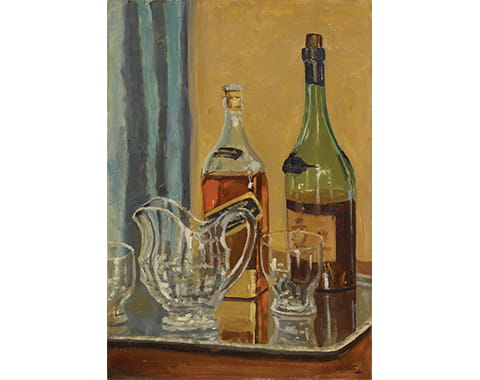
Among the 550 works in the exhibition, Jug and Bottles exemplifies Churchill’s still-life practice, showing his careful observation, confident brushwork, and vibrant use of light and colour. Like much of his work, it was painted directly in oils without preliminary sketches, reflecting his impressionistic and post-impressionistic influences. The exhibition traces his artistic journey chronologically, from tentative early attempts to bold late works, including Mediterranean harbours, wartime scenes, and Moroccan landscapes.
Though Churchill often called his paintings “daubs,” he took them seriously enough to exhibit two under the pseudonym David Winter at the Royal Academy. Complementing his works are pieces by his mentors and friends, including Sir John Lavery and Sir William Nicholson, highlighting the guidance that shaped his distinctive style.
Egypt’s new age museum

It’s hard to get away from the numbers – and the politics – when writing about the Grand Egyptian Museum (GEM), located beside the Giza pyramids and now fully open. It is the largest museum in the world dedicated to a single civilisation. Beset by delays, the project has cost Egypt more than $1.2 billion, an investment the government hopes to recoup through tourism. Last year, over 15 million visitors came to Egypt, a figure officials aim to double by 2030, with the GEM central to that ambition. Housing more than 100,000 artefacts drawn from the old Egyptian Museum in Cairo and regional collections, the vast complex now attracts around 22,000 visitors a day. Most come for the undeniable highlight: the King Tutankhamun galleries.
Measured by attendance alone, the museum is already a monumental success. Built beside the pyramids, the GEM forms part of a major redevelopment of the Giza plateau, with new roads, hotels and parks, and a visitor centre designed for international tour groups and bucket-list travellers alike. The wonder remains, but it must now be appreciated in a distinctly 21st-century way.
Just two kilometres away, the GEM appears grey and restrained by day, yet at night it glitters against the desert sky. Overlooking a vast piazza centred on the Hanging Obelisk of Ramesses II, the museum was designed by Dublin-based Heneghan Peng Architects. It covers 117 acres and is divided into 12 galleries arranged roughly chronologically, spanning prehistoric and pre-dynastic Egypt through the Old, Middle and New Kingdoms to the Late and Graeco-Roman periods. Visitors can follow historical, thematic or ‘star object’ routes. A serious visit takes four hours, though scholars could spend days here.
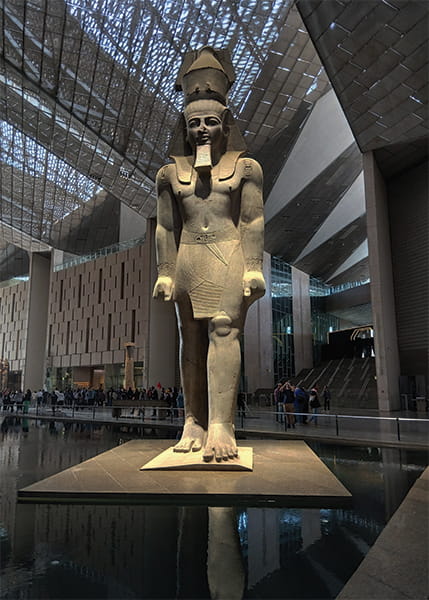
The entrance hall is dominated by a 3,200-year-old granite statue of Ramesses II, originally from Memphis and once standing in central Cairo before being relocated to protect it from pollution. Beside it, a grand staircase rises past statues, stelae and tomb fragments to a viewing platform framing the pyramids themselves.

Many artefacts relate to funerary practice, but it was the afterlife rather than death that obsessed the ancient Egyptians. Pharaohs and officials were buried with everything needed for eternal happiness. One memorable example is a group of miniature wooden soldiers from the tomb of Mesehti, a provincial governor around 2000 BC.
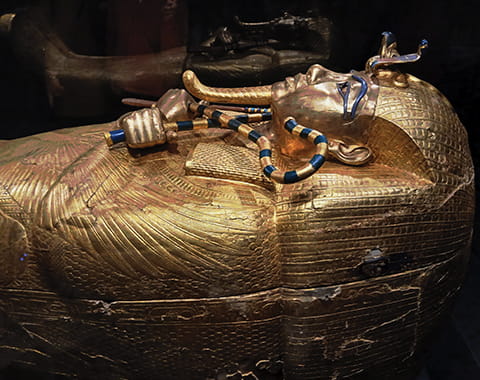
Almost all tombs were looted, even that of the relatively minor boy-king Tutankhamun. Yet nothing prepares you for the scale of what Howard Carter uncovered in 1922 and what is now displayed at GEM. The Tutankhamun Galleries shimmer with four nested golden shrines enclosing the sarcophagi, along with thrones, inlaid furniture, gold-covered chariots, alabaster vessels and hundreds of everyday objects, from sandals to baskets.
The final glory is the iconic gold mask. According to our guide, it is so priceless that no insurer will underwrite it. Gold symbolised protection, though intriguingly silver was rarer and more valuable in ancient Egypt – a reminder that treasures such as the silver coffin of Psusennes I still remain in Cairo’s original museum, now quieter since the rise of the GEM.